Home
/
Resource Center/
Case Study/
Hidden in plain sight: how one health plan closed 10,000 HEDIS gaps already documented in UM notes
Hidden in plain sight: how one health plan closed 10,000 HEDIS gaps already documented in UM notes
By training our AI to surface HEDIS-relevant evidence buried in UM clinical notes, Cohere Health helped a regional health plan close 10,000 gaps in a single end-of-year push–without manual abstraction.
Published: September 29, 2026
Topics:
Quality
Health Plan
HEDIS

The Challenge
The Challenge
Evidence hiding in plain sight
A regional health plan of ~900K members was struggling to close HEDIS gaps before year-end, even though much of the evidence it needed was already documented in utilization management (UM) clinical notes.
High-value HEDIS evidence tied to Colorectal Cancer Screening (COL-E) criteria is often documented by clinicians during UM reviews, but remains locked in unstructured clinical notes rather than flowing into quality reporting. Take the example of a member who received a colonoscopy in 2023 (providing compliance for ten years), but joined the plan in 2024–no claim, but a closed gap for years to come. Coding staff can retrieve and review it manually, but the process is slow, and it becomes slower as a plan approaches the end of the measurement year.
Closing care gaps at year-end is an ongoing challenge–not just for this health plan, but also for the industry as a whole. Unstructured clinical notes make it harder still: mining them for evidence took more time than the plan's team could spare, so much of that evidence went unexamined–and every gap left unclosed could weigh on Stars performance.
The challenge wasn't whether the evidence existed. It was whether the plan had a way to find it before the measurement year closed.
Cohere Health's Opportunity
Surface HEDIS-relevant evidence
already captured in UM clinical notes, rather than relying solely on new outreach or manual review.
Close EOY quality gaps faster
by targeting members whose UM records already contain the needed clinical evidence.
Reduce the administrative burden
on quality and clinical teams at the highest pressure point in the reporting cycle.
The Solution
The Solution
Turning existing documentation into quality evidence
To close the gap, Cohere Health partnered with the plan to implement Cohere Capture–an AI solution for HEDIS gap closure that analyzes both structured and unstructured clinical data. UM clinicals were a natural starting point, as they contain evidence spanning multiple quality measures that often goes untapped for quality reporting.
Before go-live, Cohere Health aligned Capture's models to the plan's HEDIS auditor standards to support compliance-ready results. With a short implementation timeline, Capture could be brought in for late in the measurement year, helping health plans identify and close gaps that might otherwise go undetected.
The process begins with two key inputs: the plan's existing clinical data sets–documentation already being produced but not yet linked to quality reporting–and the plan's open gap list. From there, Capture targeted the evidence, flagging which gap list members have UM records most likely to result in closure, and narrowing the review to the highest-probability cases and records. Precision AI/ML models, trained specifically on HEDIS criteria, then reason over that documentation to identify closeable evidence.
UM proved to be a high-impact starting point for this plan. As a Cohere UM customer, the plan was able to access their UM data through Cohere’s connected intelligence platform, which already contained records for 41% of members in their gap lists. Extending the same approach to a broader range of clinical sources–including appeals, risk adjustment, and provider portal submissions–can build an even more comprehensive quality program.
At the core of Cohere Health's approach is a rigorous model development process that brings together clinicians, HEDIS experts, machine learning engineers and data scientists, with output accuracy validated before deployment. Capture has the capability to take a two-pronged approach–combining automated closures with AI-assisted closures.
- In this engagement, high confidence results, validated against the plan's HEDIS auditing standards, were automated end-to-end and formatted for direct submission to the plan's HEDIS engine.
- This plan focused on automated gap closures, however Capture also includes a review tool for cases that need a closer look, with precise clinical AI pointing reviewers to the record that actually closes the gap.
Evidence that nurses and clinicians had already documented becomes evidence the plan can actually use.
The Cohere Health Difference
Three capabilities powered the result.
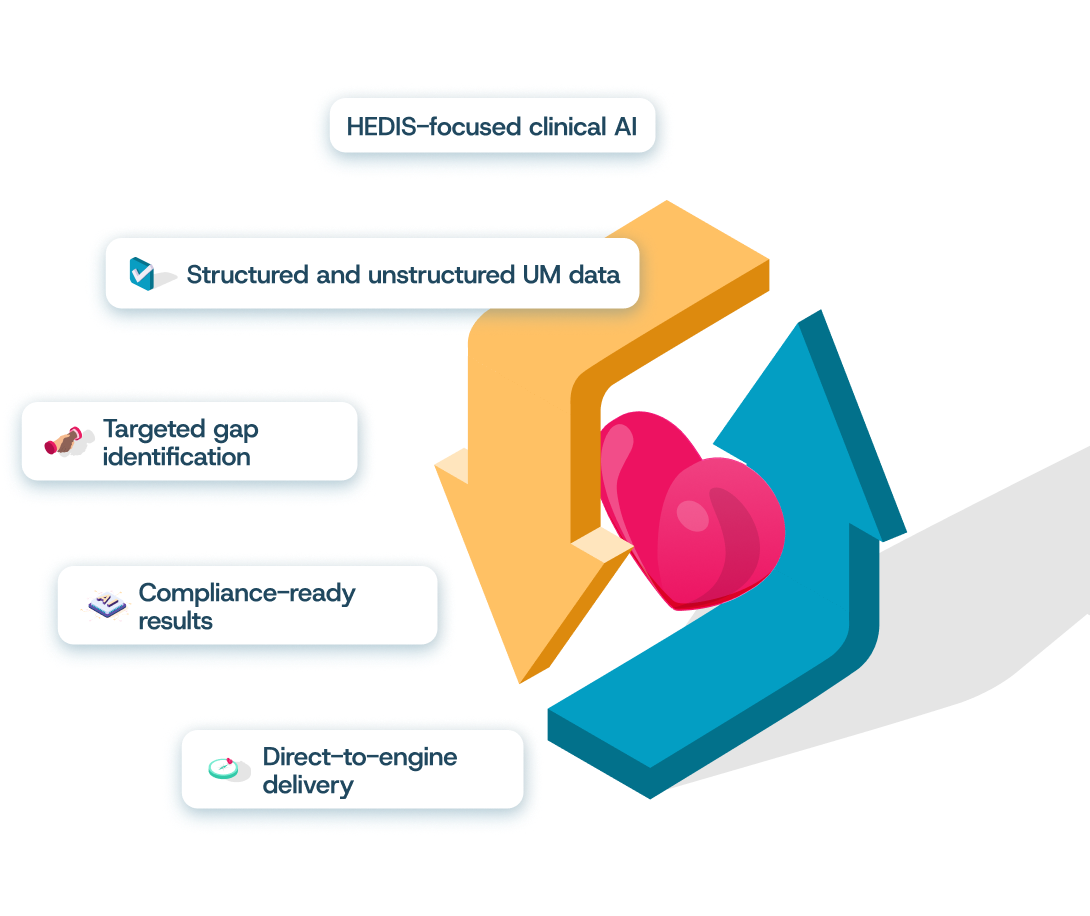
Precision clinical AI

Models trained specifically for HEDIS measures
Reasons over structured and unstructured UM documentation together
Targeted gap identification
Cross-references the open gap list against members with UM clinicals already on file
Prioritizes the members most likely to yield a closeable gap
Direct-to-engine delivery
Fully automated, compliance-ready submissions to the HEDIS engine–no additional manual work required
For closures that can't be fully automated, preps records and shows reviewers where to look
The Results
The Results
Evidence that was already there.
256
gaps closed per 1,000 EOY gap list members
25%
of targeted members closed
10K
HEDIS gaps closed in one EOY push
The numbers tell a simple story: the evidence needed to close these gaps was already sitting in the plan's UM records–it just hadn't been connected to quality reporting.

Cohere Capture didn't require the plan to generate new documentation or launch new outreach; it made evidence that already existed usable.
Results reflect this health plan's specific engagement with Cohere Capture. Individual outcomes will vary based on a plan's data, measures, and implementation.