Home
/
Resource Center/
Case Study/
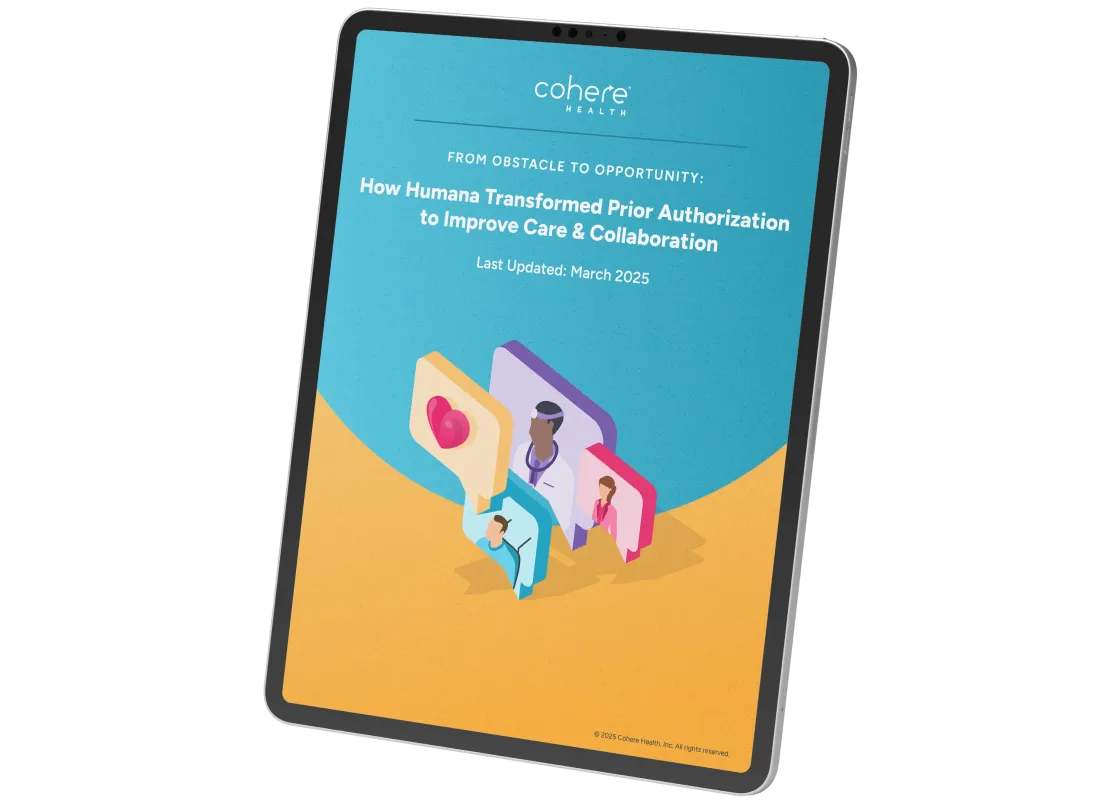
How Humana transformed prior authorization to improve care & collaboration
How Humana transformed prior authorization to improve care & collaboration
A four-year partnership that reframed prior authorization from a compliance checkpoint into a driver of collaboration, faster care, and better outcomes–now live across all 50 states.
Published: August, 2026
Topics:
Prior Authorization

Intro
Transforming prior authorization to improve care and collaboration
In January 2018, America's Health Insurance Plans (AHIP) and the BlueCross BlueShield Association, along with several provider trade groups, published a Consensus Statement on Improving the Prior Authorization Process. It called for reforms to reduce the administrative burden on health plans and providers, while improving patient care. Yet, according to the 2024 AMA Prior Authorization Physician Survey, little has changed. The report reveals that 94% of physicians believe the prior authorization (PA) process negatively impacts clinical outcomes, and 89% say it is a significant driver of burnout.
Humana, a leading health and well-being company based in Louisville, KY, recognized this urgency. Rather than treating PA as a compliance requirement, Humana saw an opportunity to reimagine it as a catalyst for collaboration and proactive care, asking: how can PA drive better coordination between health plans, providers, and patients?
In January 2021, Humana partnered with Cohere Health to reduce administrative burden and transform prior authorization (PA) into a smarter, more efficient process. The goal: improve the provider experience, optimize patient care, and strengthen payer-provider collaboration. Since then, the solution has expanded to all 50 states, covering over 5.1 million members across Medicare Advantage and Commercial plans. With 95% provider portal adoption, the platform has streamlined workflows and improved care coordination, making the process simpler for providers and better for patients.
By the Numbers
95%
Provider digital adoption rate
89%
Auto-approval rate
5 days
Time to requested service reduced by
94%
Providers “satisfied” or “highly satisfied”
The Challenges
Physicians, health plans, and patients agree that the PA process needs reform. Traditional PA workflows create unnecessary friction between providers and health plans, and remain largely manual, siloed, and transactional. This leads to excessive administrative burden, higher costs, and delays in patient care. The problem is exacerbated by a lack of clear guidance on which services require PA and what information must be submitted, leading to repeated requests for missing data. This back-and-forth wastes valuable time, frustrates providers, and disrupts patient care.
A major pain point is the lack of transparency in the criteria used to evaluate PA requests. Providers are left uncertain whether their submissions meet medical appropriateness standards, increasing the likelihood of denials and delays. This erodes trust between payers and providers, making collaboration more difficult–an essential component in advancing innovations such as value-based care (VBC).
Health plans view prior authorization (PA) from a population health perspective. Clinical variation and overtreatment drive unnecessary medical services and can put patients at risk. Across millions of patients, even a small amount of unnecessary care can cause significant harm and wasted spending. Current PA processes only consider information related to the specific service, ignoring prior patient data. Without a complete patient picture, health plans struggle to distinguish appropriate from inappropriate variation, leading to poor decisions and missed opportunities for better outcomes. That said, not all clinical variation is bad. Patients differ, and physicians may have valid reasons to choose a different care pathway based on the full context of each patient.
The primary levers of PA–approve or deny–do not ensure patients get the care they need. The only recourse for a denial is an appeal, which can cause further delays and lead to another denial. Meanwhile, health plans spend significant time and resources on cases that could otherwise be avoided.
To truly modernize PA, the industry must move beyond fragmented, one-size-fits-all decision-making. The next-generation PA process should:

Enhance transparency
by providing clear, evidence-based criteria upfront to help providers submit accurate requests the first time

Shift from a transactional to a collaborative model,
where PA becomes an opportunity to guide providers toward high-value care rather than merely acting as a gatekeeper.

Leverage patient-centered data
to make informed decisions based on a complete view of a patient’s care journey, rather than isolated service requests.

Reduce administrative burden
through automation, AI-driven decision support, and streamlined workflows that minimize unnecessary delays and rework.
The Solution
Pathways rather than transactions
Humana wanted a PA process that felt like a conversation, not a transaction: an opportunity for health plans, physicians, and patients to collaborate and learn from each other. That meant finding a technology partner who combined machine learning, advanced analytics, and deep clinical expertise to raise the standard of care while reducing administrative burden and provider/patient friction–getting to a better "yes."
“It’s about people, process, and technology; we’ve got tolead this from a systems thinking mindset. Then let’s have that thoughtful conversation based on evidence-basedcriteria.” They took a close look at the current system, starting with physician practices. “If we can improve the provider experience and if we can shorten turnaround time,” says Stephens, “that will have a positive impact on their patients–our members.”
— Lisa Stephens, SVP, Clinical Operations, Humana
Humana staff even volunteered to file preauthorization paperwork for a few practices themselves, gaining firsthand insight into the burden the current process created. The goal wasn't to eliminate PA, but to transform it–reducing administrative burden while improving quality of care and outcomes.
In the current system, a single patient's care can trigger a maze of separate requests–different vendors, different filing methods, different passwords–for what should be one connected treatment plan. This slows the patient journey without improving care or collaboration.
The Cohere Health platform changes that. It gathers clinical data upfront, integrates directly with EMRs, and lets physicians lay out a patient's full projected clinical pathway–comparing it against accepted clinical standards to approve multiple services and procedures simultaneously. For musculoskeletal conditions, the platform is built on evidence-based AAOS guidelines: if a physician requests more sessions than the standard of care calls for, the system approves what it can instantly and flags the rest for fast manual review–reducing overtreatment while speeding up time to care.
The impact extends beyond the authorization itself. For certain spinal fusion surgeries, surgeons indicate a post-acute care preference directly in the workflow for 59% of cases. When home health is preferred, 95% of those patients actually receive it–driving shorter length of stay and more timely post-acute rehab.
The Rollout
Early success and ongoing impact of Humana and Cohere Health's partnership
In January 2021, Cohere Health launched its platform in 12 states for Humana members with musculoskeletal (MSK) conditions. Despite pandemic restrictions moving training online, providers adapted quickly–many even began using the platform on the day they signed up.
Cohere Health backed the transition with live training, online tutorials, phone support, and a feedback loop to continuously refine the platform based on real provider input. Within a month, adoption blew past Humana's already-aggressive goal, and it's continued to climb since.
"Awesome." "Like Star Trek." "Best authorization site I have used." "Makes my life so much easier." "Like cheesecake."
— Physician feedback on the Cohere Health platform
That kind of praise doesn't come easily from practices used to long wait times and administrative headaches. Some providers have even said they knock out Cohere Health requests while on hold with other health plans–a small detail that says a lot about how much friction the old process still carries elsewhere.
Evidence-based decisions have cut nurse review hours by 54%, freeing clinical staff to focus on patient care. The system also learns over time, using machine learning to spot strong care patterns and fast-track future requests from high-performing practices. Health plans also gain a clearer, pathway-based view of each patient's care journey, rather than a procedure-by-procedure snapshot.
The results spoke for themselves. Complication rates after hip and knee replacements dropped under Cohere Health's management, with 16% of inpatient arthroplasty cases shifting to more appropriate, lower-cost outpatient settings. By surfacing when physical therapy hasn't yet been tried before surgery, the platform has also helped prevent unnecessary procedures–reducing medically unnecessary surgeries by 32%–all while delivering 15% greater savings than Humana's previous program.
Next steps
A partnership that continues to grow
What started as a 2021 pilot has grown into a long-term partnership. Cohere Health and Humana continue to evaluate the platform's impact across four dimensions: reducing administrative burden, enhancing access to care, improving quality, and driving better patient outcomes and lower healthcare costs.
Both organizations work directly with physician practices to understand how the platform is shaping care delivery, using that feedback to guide continued innovation. Over time, the partnership has expanded to include primary care providers, enabling more coordinated care for patients managing multiple conditions, and helping reduce readmissions and address social determinants of health. That expansion continues to show results: 42% of authorizations now use a care path, 21% of requests use episode-based care paths, and there has been a 9% shift from inpatient to outpatient cardiology procedures.
Prior authorization remains a persistent pain point across the industry. Where others see friction, Cohere Health and Humana continue to find opportunities to rebuild the process around patients–positioning Humana as a leader in patient-centered care.

95%
Provider digital adoption rate

89%
Auto-approval rate

5 days
Time to requested service reduced by

21%
Requests using episodebased care paths:

94%
Providers “satisfied” or “highly satisfied”:
Quality measures:

Shift of IP to OP setting (cardio): 9%

Athorizations using a care path: 42%
References
- American Medical Association. 2024 AMA Prior Authorization Physician Survey. February 2025. Available at: https://www.ama-assn.org/system/files/prior-authorization-survey.pdf.
- Based on Cohere Health data as of Q3 2024.
- Cohere Analysis of Humana PA Records Q1-Q3 2021, November, 2021.
- Cohere Analysis of Humana Claims Dates of Service Q1-Q2 2021, September, 2021.
- Based on Cohere Health data as of Q2 2024.
- Based on Cohere Health data as of Q4 2023.
- Humana CQIC Executive Summary, September, 2021.
- Cohere Analysis of Humana Prior Authorization Records Q4 2022.
- Humana internal estimates.