CMS is retiring fax submissions. Is your prior auth experience ready?
Published:
May 5, 2026
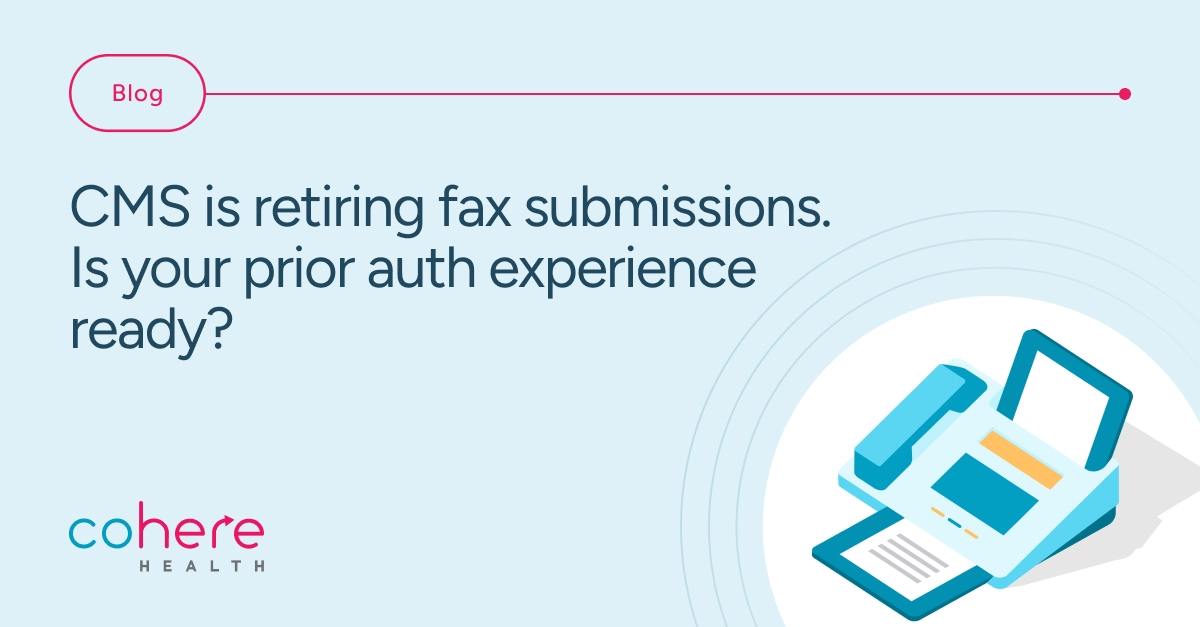
The familiar hum of the fax machine is expected to fade from within the four walls of a provider.
The Centers for Medicare and Medicaid Services (CMS) recently announced a major rule designed to phase out fax and mail-based healthcare submissions–currently scheduled to take effect in the coming years, though timelines may evolve. This shift is projected to save taxpayers nearly $781.98 million per year.
At face value, this feels like long-overdue progress, but beneath the surface, it exposes a more immediate challenge: if fax disappears, what will actually replace it?
The reality of EHR-based submissions
With fax going away, many industry leaders assume that direct EHR-based submissions will immediately fill the gap. Don't fall into the trap of assuming all providers will switch their workflows overnight. CMS-0057-F represents a meaningful step forward for interoperability and prior authorization reform–but it is a mandate for health plans, not for providers. And it does not resolve the underlying complexity of provider-side infrastructure.
The reality is far messier: fragmented systems, inconsistent capabilities, and significant financial barriers to upgrade.
Why EHR-based workflows won’t scale (yet)
Even with the momentum generated by CMS-0057-F, many provider EHR systems lack the baseline functionality needed to submit requests for all types of healthcare services. Usability challenges and workflow misalignment within EHR platforms remain widespread, making documentation and patient record review burdensome for clinicians. Upgrading these systems to support electronic prior authorization (ePA) submissions is often prohibitively expensive. It places a heavy financial and administrative burden on smaller provider practices that lack the resources for large IT budgets.
And even if upgrades were feasible, standardization remains elusive. Healthcare IT is deeply customized, and EHR implementations can vary significantly across organizations. Because of this intense customization, there's a long tail of random, specialty, or homegrown EHRs. Many of these legacy systems simply won't connect via modern API standards. When providers find themselves unable to submit authorization requests directly through their EHR, they'll naturally reach for the next most accessible option.
Previously, that fallback was the fax machine. Going forward, it will be provider intake portals.
Intake portals aren’t the fallback–they’re the bridge
Fully interoperable digital prior authorization workflows remain the industry's long-term goal, and initiatives like CMS-0057-F are an important step in that direction.
Yet many providers still face significant barriers to fully EHR-based prior authorization workflows, including costly system upgrades, fragmented implementations, and limited technical resources. In the meantime, they need an accessible, reliable way to submit requests.
That’s where intake portals play a critical role. They offer a practical path forward during this transition–requiring no infrastructure overhaul, no costly integrations, and no major workflow redesign. Just as importantly, portals can be built and optimized to be highly provider-friendly. Developers can continuously update the user interface based on provider feedback, ensuring the workflow remains intuitive and efficient.
When designed by prior authorization experts who understand clinical workflows, intake portals also create opportunities for better upstream interaction. Instead of relying solely on downstream interventions–like additional documentation requests, peer-to-peer calls, and appeals–plans can engage providers earlier in the process, at the point of submission.
From intake portals to intelligent experiences: The Cohere Health(R) advantage
A basic intake portal solves the access problem, but an intelligent intake portal transforms the entire experience. Cohere Health’s approach centers on embedding intelligence directly into the provider workflow–using real-time nudges, contextual guidance, and AI-driven data capture to simplify submission without sacrificing clinical rigor.
By doing so, health plans can guide providers toward the most appropriate service and care setting in real time–thereby driving more approvals at the point of submission and reducing unnecessary back-and-forth throughout the process.
Cohere Health built its platform to be exceptionally provider-friendly, resulting in 94% provider adoption and a Net Promoter Score (NPS) of 69–a measure of user loyalty that reflects the difference between users who would recommend the experience and those who would not. Our consistently high NPS reflects our commitment to respecting provider workflows and reducing administrative friction.
With Cohere Health, organizations can reduce reliance on burdensome provider-facing questionnaires by capturing more complete and relevant clinical information directly within the workflow. Our platform uses advanced AI-driven data extraction to automatically pull relevant clinical information. This technology further reduces provider burden by helping to reduce the need for manual questionnaires, which are tedious and often yield inaccurate or incomplete responses. By capturing the right data in context, the platform helps to accelerate decision-making and reduce back-and-forth communication.
What health systems should do next
The transition away from fax machines is inevitable, but it doesn't have to be painful. As the industry adjusts to a fax-less future, they need reliable, intelligent alternatives that don't require massive infrastructure overhauls.
Health plans that recognize this will move faster and more effectively by investing in solutions that meet providers where they are today, while laying the groundwork for where the industry is going. In a fax-less world, the question isn’t whether you have an intake portal, but whether your intake portal is ready to carry the load.
Learn more about how Cohere Health supports health plans during this transition.
Available For Download
Written by

Cohere
Health
Cohere Health’s clinical intelligence and operations platform and agentic AI-powered solutions connect health plans’ strategic goals and providers’ needs, optimizing the speed, cost, and quality of care. With an enterprise approach that streamlines payer-provider decision-making across the care continuum–including policy, prior authorization, payment accuracy, and more–the company improves collaboration and reduces burden, resulting in up to 9x ROI and 94% provider satisfaction. Cohere Health is recognized on TIME’s World’s Top HealthTech Companies 2025 list, on the 2025 Inc. 5000 list, and by numerous industry analysts.
Stay ahead with expert insights on transforming utilization management and payment integrity—delivered straight to your inbox.