Other competitors
Traditional, portal-only approach
How decisions are supported
Clinical-grade AI surfaces evidence from structured and unstructured data, builds longitudinal patient records, and supports transparent, evidence-backed real-time approvals where clinical evidence and policy logic support automation.
Relies on clinical questionnaires or structured data downloads that don't provide enough patient detail for accurate decisioning.
AI approach
More than 475 clinician-trained, fine-tuned precision AI models extract evidence from unstructured clinical attachments, map it directly to policy criteria, and surface it to reviewers. Every recommendation is traceable to specific evidence, not a probability score.
Questionnaire-based AI or surface-level ML that can yield inaccurate responses and miss critical clinical nuance, limiting decisions to what a provider types into a form, not what's documented in the clinical record.
Automation depth
Supports up to 85% of real-time prior authorization approvals based on your unique guidelines, policies, and rules.
Limited real-time capabilities; often recommends rather than decides, without integrated data and rules.
Reviewer support
AI-powered review assist empowers in-house clinicians to focus on high-stakes inpatient and outpatient cases with greater speed and accuracy.
Limited support for clinical review workflows; most tools address only part of the authorization process.
Provider experience
Flexible intake across portal, fax, phone, and EHR; 94% provider satisfaction; physicians reclaim up to eight hours per week.
Limited intake flexibility, often portal-only, which can shift fax and phone follow-up burden back onto payer staff and providers.
Transparency
In-workflow policy transparency with real-time approvals, not a black-box prediction; detailed reasoning available even for complex and peer-to-peer reviews.
Limited visibility into decisioning criteria made on incomplete clinical data; opaque workflows contribute to provider abrasion and care delays.
Policy management
Policies become digitized operational assets that power consistent decision-making, automation, auditability, and CMS-ready interoperability.
Policies live in static documents that create update delays, version confusion, and limited transparency.
Policy intelligence
Evidence-based Prior Auth List (PAL) analysis and benchmarking, and policy codification services support NCDs, LCDs, third-party policies, and custom policies across your full policy hierarchy.
Portal-only approaches often lack integrated policy codification services or ongoing policy maintenance. Does not offer PAL analysis or benchmarking.
Long-term operational value
UM is an entry point—not the ceiling. Connected intelligence extends across appeals, care management, quality, claims, and payment integrity. Every decision informs the next. One platform, compounding value.
Upstream-only capabilities often limit downstream analytics and operational scale. Network connectivity across functions without shared clinical intelligence between them.
Why Health Plans Choose Cohere Health
Our innovative approach combines the best of insourcing with precision AI and a modular platform, helping health plans support faster, more consistent care decisions.

Lower administrative costs
Cohere Health's AI transparently and thoughtfully supports real-time approvals for up to 85% of eligible prior authorization requests, helping reduce manual review volume and reclaim team capacity for critical cases.

Better decisions, fewer delays
Our AI-supported clinical review doesn't predict what should be approved–it extracts the clinical evidence that proves why it should be. Grounded in our ability to extract insights from unstructured data in attachments, helps in-house clinicians apply policy consistently and make faster, defensible medical necessity determinations on the cases that need clinical judgment most.

Providers who feel supported
Our flexible intake options, real-time transparency, and provider-preferred portal reduce administrative burden and drive high network satisfaction.
Not sure how to evaluate your options?
Our utilization management vendor analysis guide helps you drive focused vendor discussions and make informed decisions that deliver long-term operational value.
What Others Are Saying
Connected intelligence
What happens after the auth decision matters just as much
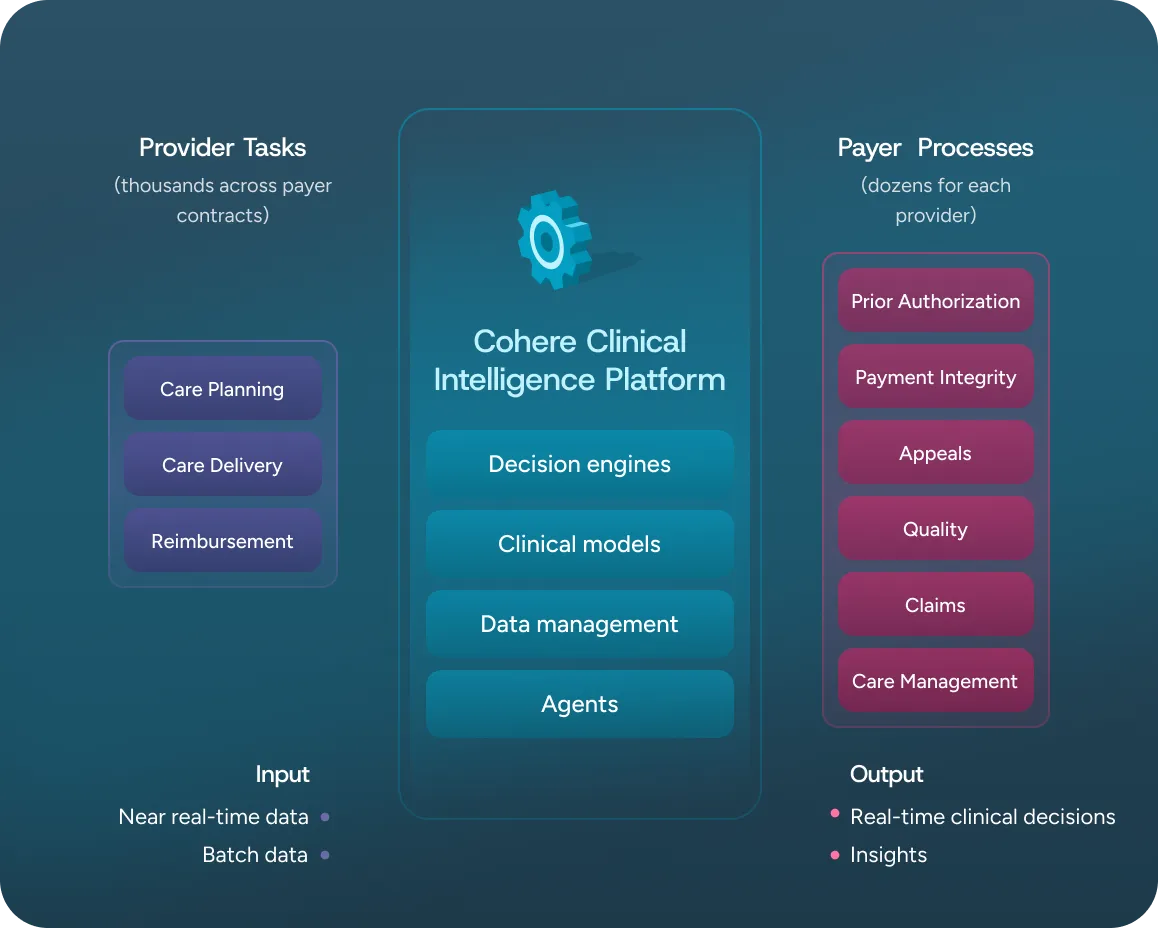
Most UM vendors end at the determination. Cohere Health's clinical intelligence platform extends across the full operational lifecycle—from policy management, PAL optimization, authorization, and appeals, through care management, quality, claims, and payment integrity. Because every function draws from the same clinical foundation, intelligence compounds across your organization rather than siloing inside a single workflow. Explore solutions on our connected intelligence and operations platform.

See what **end-to-end** UM support looks like in practice.
See how end-to-end UM support helps your team accelerate decisions, strengthen clinical consistency, and reduce administrative cost across the authorization workflow.